

AMD Ryzen 7 4800H Review
Following upward to our coverage of the Ryzen 9 4900HS, today nosotros're going to exist testing the AMD Ryzen 7 4800H laptop processor. While the 4900HS was definitely a very interesting part, it'southward probably not going to be equally widely bachelor as the 4800H which targets a more than mainstream market place. And then today's review is going to cover what's likely going to be the most popular Ryzen H-series APU amidst buyers and laptop models across different brands.
The Ryzen 7 4800H comes configured with a default 45 W TDP rather than the lower 35 W AMD targets for their premium HS-serial SKUs. Nevertheless clock speeds between the 4800H and 4900HS are like at a 3.0 GHz base of operations and 4.three GHz boost for the 4900HS compared to 2.ix GHz and 4.two GHz for the 4800H. Cache size is the same at viii MB L3, and of course, we're getting viii cores and xvi threads. In essence, the 4900HS is set to provide like performance to the 4800H at a lower level of power consumption, at least in theory.

The other central difference between the two CPUS is the integrated graphics. The Ryzen nine comes with a fully unlocked Vega GPU with viii compute units and a 1750 MHz max frequency. Meanwhile, the Ryzen 7 4800H has 7 compute units clocked at 1600 MHz. On paper in that location'southward a divergence, but we don't expect any H-serial laptops to launch without a discrete GPU pairing, making the point moot.

For testing the Ryzen vii 4800H we bought an Asus TUF Gaming A15 laptop which is widely available in the US. Information technology's actually a dainty value offering at just a $1,000, comes with the 4800H, 16GB of DDR4 memory and a detached GTX 1660 Ti GPU at 80W. There'due south also a RTX 2060 model available for a little extra. You lot likewise get a 15-inch 1080p display, a basic design with no obvious flaws, in what appears to be a suitable mid-range gaming laptop.

A few quick notes on the examination setup. You'll see across this review a number of dissimilar laptop CPUs in the charts and, at times, GPU configurations also. The data in the charts is an average from the laptops nosotros've tested with the given hardware. You can check out the full list of laptops tested here.
Testing laptop components tin be more challenging than desktops equally each configuration can vary in cooling and other hardware, then these averages are meant to illustrate how a 'typical' system volition perform. The boilerplate score exclude models with single channel retentiveness or other situations that heavily throttle the components at paw, nosotros've tried our all-time to create apples-to-apples data as possible.

We've also run every laptop at stock settings and unless otherwise specified. For Intel CPUs this generally means a 45W long term PL1 limit, and for AMD processors it's 45W on the 4800H and 35W on the 4900HS and 3750H.
Benchmarks
Starting with Cinebench R20, we know Ryzen 4000 is a stiff performer in this workload, however the 4800H does perform a little differently to the 4900HS. With a higher TDP and longer boost, the 4800H is ~ii% faster in multi-thread, but 2% slower in single-core. The higher heave frequency of the 4900HS appears to brand a difference here.

Against Intel CPUs it'south a not-contest. The 4800H is 47% faster than Intel's Core i7-10875H and around 67% faster than the Cadre i7-9750H. The only manner Intel's H-series parts can get close is with power limits thrown out the window, but fifty-fifty at 90W with an eight-core Core i9-9880H it tin can't match the 4800H; AMD's option is all the same 15% faster.
Intel's latest parts do concur a unmarried-thread performance advantage, especially over the 4800H. This APU is iii% behind the 10875H, although it does outperform the 9750H which doesn't clock equally loftier as the 10875H.

Results don't change much in the legacy Cinebench R15 test. The 4800H doesn't dominate past quite as much equally it does in Cinebench R20 and falls behind the 4900HS here, but it still holds a considerable lead over Intel's Cadre i7 processors. Yes, we don't take the Cadre i7-10750H in these charts yet, although nosotros just received got one for testing this week and we expect information technology to perform similarly to the 9750H, but we'll see that soon.

Handbrake is another workload that benefits from AMD's faster multi-thread performance. The 4800H ends up 32% faster than the Cadre i7-10875H, every bit well equally 56% ahead of the Core i7-9750H. If you program on using your laptop for video encoding or transcoding on the go, there's no ameliorate selection on the market right now than Ryzen. In a test that takes over 30 minutes to consummate, the 4800H is ~5% ahead of the 4900HS: despite having a lower base clock, its higher TDP allows for college clock speeds in practice.

The 4800H holds a significant reward in decompression over Intel's CPUs. We're looking at a 32% operation advantage over the 10875H. However, compression isn't this Ryzen APU'southward strong adjust, coming in 9% behind Intel's viii-cadre function. In both circumstances, the 4800H is superior to Intel's often similarly-priced Core i7-9750H.

Some other workload where we see equivalent performance betwixt the 4800H and 4900HS is Microsoft Excel in a data heavy spreadsheet. While the 4800H is 8% faster than the Cadre i7-9750H, it's 8% slower than the 10875H, so depending on which two laptops yous're tossing up between, Intel might take an advantage.

Blender is another multi-thread workload that runs very well on Ryzen, coming in 44% ahead of the Core i7-10875H and 73% ahead of the Cadre i7-9750H. Similar with video encoding, if you plan on doing CPU-based rendering tasks and are using an application that is heavily multi-threaded, at that place is no reason to choose Intel.

A new productivity test that we are introducing is code compiling, in this case compiling GCC. This workload is a mixture of multi-threaded and single-threaded sections, and takes quite a while to complete. Comparison Ryzen and Intel, like the previous results, the Ryzen vii 4800H is significantly quicker: 27% faster than the i7-10875H and 56% faster than the i7-9750H.


Testing using PCMark 10'due south lighter productivity test we see that the 4800H is 14% faster than the 9750H, and 3% faster than the 10875H, while falling slightly backside the Ryzen 9 4900HS. The margins compress a chip in the Essentials test, now placing the 10875H alee, due to increased single-core usage.

MATLAB performance is fifty-fifty between the Ryzen vii 4800H and Cadre i7-10875H using R2020a and the built-in benchmark, while coming in virtually x% alee of the 9750H. This makes Ryzen a decent choice for engineers merely it's not the same overwhelming winner that information technology is in other heavily multi-threaded workloads.

Acrobat PDF exporting is ane of the hardest tests for Ryzen to perform well in, as it's fully single-threaded. The 4800H falls xvi% behind the 10875H here, while matching the 9750H. We've seen a few times now that pure single-thread workloads are a weakness of the 4800H that only clocks upward to iv.two GHz.

AES encryption performance is nonetheless strongly in favor of AMD where you can see upwardly to a 35% gain in this workload over Intel's competition.


In Photoshop Iris Blur nosotros run into equivalent operation between the Ryzen 7 4800H and Ryzen nine 4900HS. The CPUs are ~6% slower than the 10875H, but 7% faster than the 9750H. Ryzen also falls behind Intel in Puget's Photoshop benchmark, although it'due south of import to note hither that the GPU does have a minor influence in some tests.

Using DaVinci Resolve for benchmarking has been hotly requested, and so we're besides adding it to this review for the first time, through Puget's workload. DaVinci benefits hugely from GPU performance and ofttimes performance is dictated more past the GPU than CPU. And then when comparing identical GPU configurations, the 4800H pulled a significant 21% alee of the 9750H. This isn't every bit large of a margin as nosotros accept seen between the 2 processors, just given how compute-heavy the app is, it's a very promising sign for those that video edit in Resolve.
I think information technology's also worth pointing out that while the 1660 Ti in our exam organization is ordinarily near twenty% slower than the RTX 2070 Super Max-Q in our 10875H test system, the Gigabyte Aorus 15G, our Ryzen configuration is only 12% slower. Given the Aorus organisation is over twice as expensive, the compute value for Resolve sides with these mid-range Ryzen systems so long as Intel are unable to offering eight cores effectually this price point. Of course, those that desire outright functioning volition demand to opt for Intel while Ryzen systems lack powerful discrete graphics.


Let'due south finish off the productivity tests with a look at Premiere. I've decided to pull the single-laissez passer encode that we normally show, because recently with the Premiere 14.2.0 beta, Adobe has introduced hardware accelerated encoding on Nvidia and AMD GPUs. Previously this characteristic was restricted to but Intel QuickSync, which was one reason to buy an Intel laptop over AMD. Given this advantage volition no longer be there in the next version of Premiere, it doesn't make much sense to recommend Intel for QuickSync in Premiere anymore.
A brief look at Premiere 14.2.0 performance with hardware accelerated encoding on our Nvidia detached GPU shows the Ryzen 7 4800H performing xiii% ameliorate than the Cadre i7-9750H in laptops with the aforementioned GPU, at least in Puget's export test, while matching the Core i7-10875H with a faster GPU.


Other tests show the Ryzen 7 4800H performing well in Premiere. For 2 laissez passer encodes that don't utilize hardware acceleration, Ryzen holds the performance crown which is no surprise after what we've seen in other multi-thread workloads. Ryzen is also faster for using features like the Warp Stabilizer, coming in 20% ahead of the 10875H and 23% ahead of the 9750H. And then for alive playback of media in the timeline, the 4800H is equal to or faster than Intel'southward Core i7 CPUs that we've tested in the beta version of Premiere.
Where Are the Gaming Results?
At this point in the review we were hoping to include some gaming functioning numbers, however we ran into some anomalies with the examination systems nosotros were using. Instead of delaying this review further, we will revisit 4800H gaming in a follow up review presently.
We wanted to brand sure the numbers are 100% accurate before publishing them and this involves the rather tedious process of checking with OEMs to make certain everything is working perfectly.
This review has gone to lengths to provide a full productivity operation outlook, but rest assured nosotros'll be dorsum with a proper investigation into Ryzen 4000 gaming when we can be sure the numbers are cogitating of the existent world, final experience.
Performance Comparisons
Ryzen 7 4800H vs Core i7-9750H

Here are some overall comparisons between the Ryzen 7 4800H and other key CPUs it'll be competing against. First we accept the Core i7-9750H, which we expect to be close in performance to the newer Core i7-10750H. Paired with the aforementioned GPU, the 4800H was universally faster, often past huge margins. In long term multithreaded tasks similar Handbrake, Blender or code compiling, the 4800H was over 60% faster, making it the obvious selection for anyone that does these sorts of things with their laptop.
But fifty-fifty in more GPU heavy workloads similar Premiere (when properly accelerated), DaVinci Resolve or Photoshop, the 4800H still held a performance pb with the same 1660 Ti in the systems. And then in lighter productivity tasks we saw everything from marginal gains, to 10% improve functioning or higher. Comparing these two CPUs that sit down in the same price bracket is a domination to AMD.
Ryzen 7 4800H vs Core i7-10875H
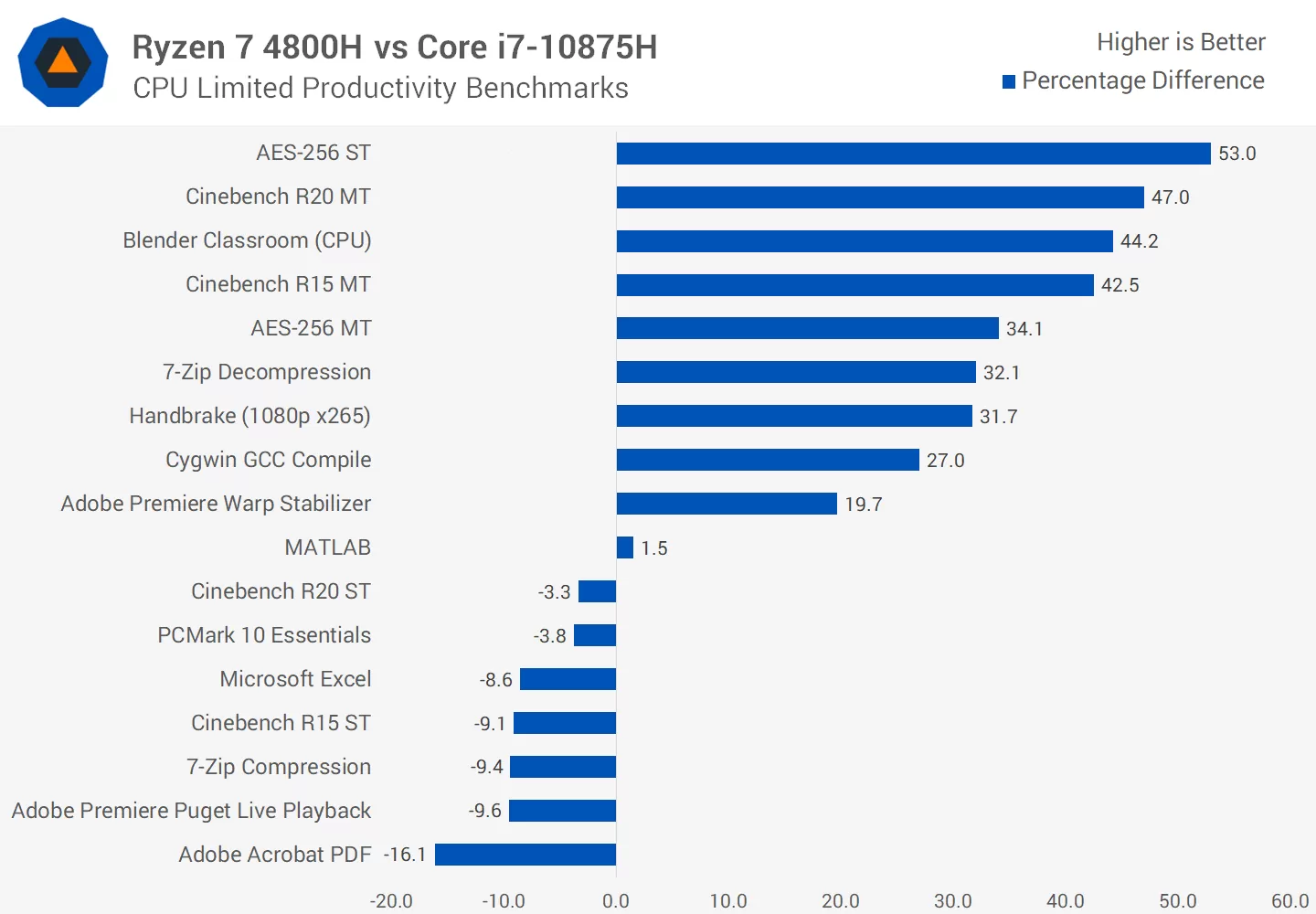
Comparison the 4800H to the 10875H is a slightly dissimilar story in that AMD'southward 4800H does not hold the unmarried thread functioning crown, it's unremarkably around ten% slower in these sorts of workloads compared to Intel'due south new 8-cadre offering. Still, the 4800H is all the same by far the best choice for multithreaded workloads, providing twenty to 40 percentage more than performance. For encoding videos that could make a significant difference to how productive you are with your laptop.
Ryzen seven 4800H vs Cadre i9-9880H

Intel struggles to compete with AMD's 45W offering, fifty-fifty in a best instance scenario with the Core i9-9880H running at a 90W power limit. The 4800H is still 5 to 15 percent faster in longer term workloads, which highlights AMD's superior efficiency.
Ryzen 7 4800H vs Ryzen nine 4900HS

And then finally we accept a look between the Ryzen vii 4800H and Ryzen nine 4900HS, a battle of 45W versus 35W. The 4900HS is quite impressive hither, especially in some shorter term and single threaded tests where information technology is marginally faster. Withal in longer term workloads, we are looking at the 4800H being around 5% faster. Even so, given the 29% difference in power, information technology's impressive that the 4900HS can offer almost the same operation as the 4800H. And it's non like the 4800H is inefficient or anything, it's far and away meliorate than Intel'due south processors, it's just the 4900HS is a stride better over again.
Wrap Upward
Our closing thoughts on the Ryzen 7 4800H are similar to what we said in the 4900HS review, given the ii parts are very close in terms of functioning. The 4800H is an extremely impressive APU for productivity, offering multi-thread functioning that's a class in a higher place what Intel can offering, while being more efficient at the aforementioned fourth dimension. Intel's 14nm process applied science just isn't up to scratch for these sorts of tasks compared to what TSMC is delivering on 7nm.
In our Ryzen nine 4900HS review we spent some time going through some of the drawbacks for AMD's 8-core compared to Intel'south 8-core, including that top-cease single-thread performance isn't quite there and at that place are some cache and latency limitations. That'south still true when you pit the 4800H confronting the Core i7-10875H, just we think this comparing is almost irrelevant when you examine the market.

Right now the Ryzen seven 4800H is not competing with the Core i7-10875H. Laptops that utilize the i7-10875H start at $1,800. Meanwhile, the 4800H is squarely competing with more affordable laptops that are equipped with Intel'southward six-core offerings in the i7-9750H and i7-10750H, and we've but seen the 4800H hands beat the 9750H beyond the board. Of class, at some point we could encounter the Ryzen 7 4800H become a premium selection to take on the i7-10875H, that should exist interesting.
There are even so question marks over just how many Ryzen 4000 options in that location will be in the market place and how piece of cake it will be to buy i. Currently, Ryzen 7 4800H systems are in hot need, with basically everything sold out, and in the three weeks since we beginning looked at the 4900HS, we haven't heard about many other systems hitting the market.

Honestly, we tin empathize some apprehension on the OEM side. The Ryzen seven 3750H was not a good laptop APU, information technology was significantly slower than Intel's Core i7s, then waiting to run across how these new Zen two options perform and how they are received by the public seems reasonable. But at present we know they are skillful, the 4800H is more than twice every bit fast as the 3750H and judging by comments everywhere, people want Ryzen laptops. Information technology'll be upwardly to OEMs to make this happen.
Shopping Shortcuts
- AMD Ryzen seven 4800H Laptops on Amazon
- AMD Ryzen ix 4900HS Laptops on Amazon
- Asus TUF Gaming A15 Laptop on Amazon
- Nvidia RTX 2060 Max-Q Laptops on Amazon
- Nvidia GTX 1650 Max-Q Laptops on Amazon
- Core i9-9880H Laptops on Amazon
- Core i7-9750H Laptops on Amazon

Source: https://www.techspot.com/review/2018-amd-ryzen-4800h/
Posted by: johnsontindst.blogspot.com
0 Response to "AMD Ryzen 7 4800H Review"
Post a Comment